
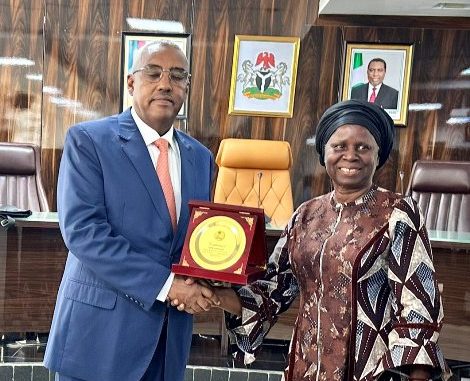
The INEC, AU electoral partnership has received a major boost following a high-level engagement between Nigeria’s Independent National Electoral Commission (INEC) and an African Union (AU) delegation ahead of the 2027 general elections.
The AU delegation was led by His Excellency Demeke Mekonnen, Head of Mission and former Deputy Prime Minister and Minister of Foreign Affairs of the Federal Democratic Republic of Ethiopia. The team paid a courtesy visit to INEC as part of the AU’s Pre-Election and Needs Assessment Mission to Nigeria, scheduled for September 13 to 19, 2026.
The delegation was received by INEC’s Acting Chairman, Professor Rhoda Gumus, who represented the Chairman of the Commission, Professor Joash Ojo Amupitan, SAN.
INEC, AU Electoral Partnership Focuses on 2027 Election Preparedness
Speaking during the engagement, Mekonnen said the AU mission was aimed at assessing Nigeria’s preparations for the 2027 general elections, identifying possible gaps and recommending measures that could contribute to a successful electoral process.
He said the AU was particularly interested in key areas including voter registration, electoral technology, logistics, funding, inclusion, transparency, electoral disputes, security and result management.
According to Mekonnen, the pre-election period remains critical to the success of the entire electoral process, making credible voter registration, transparent procedures and public confidence essential.
“We want to facilitate support and identify gaps, and for possible remedies and corrections for the successful election process,” Mekonnen said.
Responding to the delegation, Professor Gumus conveyed the warm compliments of the INEC Chairman and welcomed the AU mission, describing its engagement with the Commission as timely and significant to Nigeria’s democratic development.
She said Nigeria and the African Union share a commitment to democratic standards, institutional integrity and credible electoral governance across the continent.
Gumus disclosed that INEC was preparing for the 2027 general elections on an unprecedented scale, with the country’s voter population approaching 100 million, 176,846 polling units and a workforce of more than 1.4 million personnel.
She noted that recent off-cycle elections had also provided opportunities for the Commission to test and evaluate electoral reforms under the new legal framework.
The Acting Chairman highlighted several measures being implemented by INEC to strengthen electoral administration, including the deployment of the Bimodal Voter Accreditation System (BVAS), result viewing through the IReV portal and enhanced inter-agency security coordination.
Gumus also disclosed that INEC was working with the National Identity Management Commission (NIMC) through the Continuous Voter Registration Portal to audit, verify and clean the voter register.
The collaboration is expected to help strengthen the integrity of Nigeria’s voter database ahead of the 2027 elections.
Despite the reforms and preparations underway, Gumus acknowledged that Nigeria’s geographical size and complexity continue to create technological, logistical and political challenges for election management.
She stressed that electoral integrity cannot be achieved by one institution alone and requires cooperation among government agencies, political stakeholders, civil society, citizens and international partners.
“Electoral integrity is a multi-sectoral endeavour, and international technical support remains vital to bridging operational gaps,” she said.
The AU’s assessment mission is therefore expected to provide an independent perspective on Nigeria’s electoral preparations while identifying areas where additional technical assistance and institutional support may be required.
The engagement underscores the growing importance of international cooperation as Nigeria prepares for the 2027 general elections.
With the scale of the electorate, polling infrastructure and personnel involved, continued collaboration between INEC and the African Union could help strengthen electoral preparedness, improve public confidence and address potential operational gaps before Election Day.
The outcome of the AU Pre-Election and Needs Assessment Mission could consequently provide important recommendations for improving Nigeria’s electoral process and reinforcing the credibility of the 2027 elections.


Be the first to comment