
Packaged by Adegboyega Adekunle
2027 Oyo governorship election is gradually assuming a shape that makes one conclusion increasingly difficult to ignore: the contest should not be reduced to a two-horse race between Senator Sharafadeen Alli of the All Progressives Congress (APC) and Abimbola Adekanmbi of the Allied Peoples Movement (APM).
Both men are unquestionably central figures in the emerging contest. Alli has emerged as the APC’s governorship candidate, while Adekanmbi is the APM candidate and has received the public backing of Governor Seyi Makinde as his preferred successor.
But Oyo’s political terrain is broader than the rivalry between these two candidates.
The latest candidate information available from reports on the Independent National Electoral Commission (INEC) process shows a field containing multiple candidates and parties, including Taofeek Adegboyega Adegoke of the African Democratic Congress (ADC), Oriyomi Hamzat of Accord, Hazeem Gbolarumi of the Peoples Democratic Party (PDP), as well as candidates of several other parties.
2027 Oyo Governorship Election: Alli And Adekanmbi May Dominate The Conversation — But Not Necessarily The Entire Political Equation
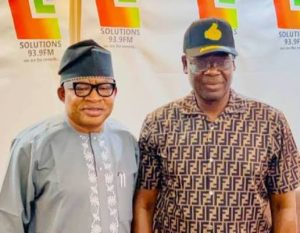
Alli comes into the election with the institutional machinery of the APC behind him. The party formally unveiled him in July and simultaneously announced Adesoji Adedeji as his running mate, while emphasising reconciliation and grassroots mobilisation.
Adekanmbi, meanwhile, occupies a different political space. As a former appointee in the Makinde administration, his campaign is naturally connected to the question of continuity. When the APM adopted him as its consensus candidate, he said his administration would not derail the development direction associated with Makinde’s “Omituntun” vision.
Consequently, much of the political conversation has settled into a simple narrative: Alli versus Adekanmbi. But elections are rarely decided by headlines alone.
One candidate who makes the two-horse narrative particularly difficult to sustain is Oriyomi Hamzat of Accord.
Hamzat has already challenged the political circumstances surrounding Makinde’s endorsement of Adekanmbi, calling on the governor to allow other candidates to compete without intimidation.
Whatever one’s interpretation of that confrontation, it demonstrates that Hamzat is not positioning himself as a peripheral participant.
And the importance of an alternative political platform should not be dismissed merely because the APC and APM currently occupy much of the public conversation.
The recent political experience of the South-West also provides a reminder that established assumptions can be disrupted. The 2026 Osun governorship election, for example, produced a victory for an Accord candidate, demonstrating that an opposition platform can become electorally significant when circumstances, candidate appeal and organisation converge.
That Osun experience does not establish what will happen in Oyo. The two states have different political histories, candidates and electoral dynamics. But it is relevant to understanding why alternative-party candidates cannot simply be written out of the Oyo equation.
Then there is Taofeek Adegboyega Adegoke, the ADC candidate.
His emergence adds another dimension to the contest, particularly at a time when the ADC has become part of broader opposition discussions ahead of 2027.
There has also been confusion surrounding the ADC ticket in Oyo, with different names appearing in earlier accounts of the party’s nomination process. Current reports on the INEC display identify Adegoke as the ADC candidate.
That clarification is important because serious analysis of the election must distinguish between aspirants who contested party primaries and candidates whose names appear in the electoral process.
Adegoke therefore deserves to be treated as part of the substantive 2027 conversation, rather than as an afterthought.
Political observers sometimes make the mistake of assuming that because two candidates receive the most attention, everyone else is merely contesting for relevance.
That assumption can be dangerous. A third candidate does not necessarily have to become one of the two leading candidates in order to influence an election.
Such a candidate can attract voters who do not identify with the major platforms, force the leading candidates to address issues they might otherwise overlook, reshape alliances, influence the distribution of votes across senatorial districts and local government areas, attract politicians and grassroots structures from established parties; and alter the strategic calculations of the principal campaigns.
This is why Oriyomi Hamzat and Taofeek Adegoke cannot simply be removed from the analytical frame because Alli and Adekanmbi currently command considerable attention.
2027 Oyo Governorship Election: The PDP Factor
Another reason the “two-horse” description may be premature is the presence of the PDP.
Hazeem Gbolarumi is among the names currently identified in reports of the Oyo governorship field. The PDP’s position deserves attention because Oyo has a long history of competitive politics involving the party. Its performance in 2027 will depend on its organisation, candidate, campaign and ability to connect with voters.
The party’s presence means the election cannot be reduced simply to APC versus the party backed by the incumbent governor.
Behind the personalities is a much bigger question: what kind of government do Oyo voters want from 2027 onward? Adekanmbi’s candidacy presents a continuity proposition linked to the current administration. Alli’s candidacy provides an opposition alternative through the APC. Hamzat, Adegoke, Gbolarumi and the other candidates offer different political platforms and propositions. The eventual campaign will therefore have to move beyond personalities.
Issues such as infrastructure, education, healthcare, agriculture, employment, investment, security, urban development and the cost of living are likely to become increasingly important as candidates attempt to distinguish themselves.
The record of the outgoing administration will also inevitably form part of the debate. For Adekanmbi, continuity will be a central part of the political conversation. For Alli and the other opposition candidates, the campaign provides an opportunity to argue for whatever changes they believe Oyo requires. The electorate will ultimately assess those competing claims.
2027 Oyo Governorship Election: The “Surprise” Factor
Perhaps the most important reason to describe Oyo as beyond a two-horse race is the possibility of developments that cannot yet be accurately predicted.
Political alignments in Oyo have shifted before. Politicians who were allies have changed camps. Parties have experienced internal disputes. Candidates have emerged from unexpected political circumstances.
The current field itself demonstrates how fluid the process remains.
There are already reports of disputes and competing claims around some party tickets, while candidate lists have evolved as the electoral process has progressed.
Consequently, it would be premature to assume that the political configuration seen today will remain exactly the same throughout the campaign.
Oriyomi’s camp could produce a development. Adegoke’s camp could produce one. Another candidate could suddenly become more prominent. A coalition could emerge. A political realignment could change the calculations.
None of these possibilities should be presented as a prediction. They are simply reasons why the political field deserves to be watched in its entirety.
The 2027 Oyo governorship contest has certainly acquired a prominent Alli-Adekanmbi dimension. But prominence is not the same thing as exclusivity. With Oriyomi Hamzat, Taofeek Adegoke, Hazeem Gbolarumi and other candidates in the field, Oyo voters are being presented with more than two political options.
The real story of 2027 may therefore not be simply about who dominates the headlines in October 2026. It will be about who builds the broadest political coalition, who communicates the clearest programme, who connects most effectively with voters across the state, and how the alliances evolve before voters finally cast their ballots.
For now, the responsible reading of the Oyo political landscape is straightforward: Watch Alli. Watch Adekanmbi. But do not take your eyes off Oriyomi, Adegoke, the PDP and the other emerging forces.
Oyo is beyond a two-horse race.
Adekunle Adegboyega is Oyo State correspondent of Parrot Xtra Magazine and pmparrotng.com


Be the first to comment