
Nigeria’s Federal Capital Territory ( FCT) and 23 states of the Federation have received N24,450,000,000.00 from the
Conditional Grant Schemes as incentives to invest more of their resources into areas of national development priorities and the Millennium Development Goals(MDGs)/Sustainable Development Goals (SDGs).
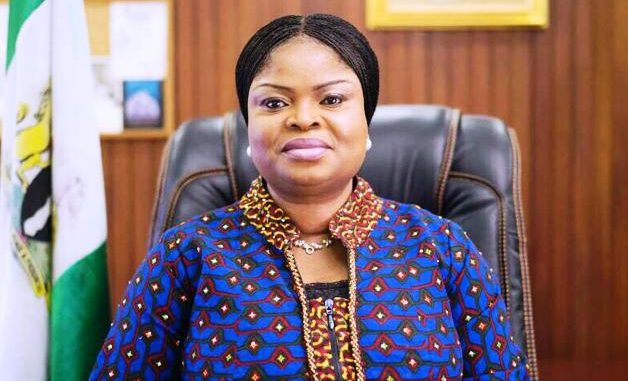
The Senior Special Assistant to the President on SDGs, Mrs. Adejoke Orelope-Adefulire, disclosed this on Thursday at the State House, Abuja.
Briefing the journalists, the SSA stated that the fund, disbursed since 2015 till date, was introduced in 2007 with a 50 percent marching grant from the federal government and 50 percent from the participating states.
According to her, the grants were targeted at education, health, water and sanitation projects and aimed at executing pro-poor projects in a consultative manner with the beneficiaries.
The SSA also said the fund was spent on the implementation of 732 water and sanitation facilities; 494 health facilities (new facilities and renovation/rehabilitation); 616 education facilities (new construction, renovation/rehabilitation of block of classrooms; 1,150 women and men were empowered/trained in vocational skills, such as sewing, knitting, detergent & pomade making etc.)
Mrs. Orelope-Adefulire said there were special intervention projects across the geo-political zones, an initiative, she affirmed, was aimed at strategic investment to fast-track the achievement of the SDGs in Nigeria.
“Between 2016 and 2021, a record number of projects have been implemented, aimed at providing essential services to accelerate the achievement of the SDGs, by ensuring no Nigerian is left behind.
“In the education sector, 8,008 classrooms were constructed and 305 renovated with furnishings to strengthen basic education across the country.
“A total of 4,845 Desktop and Laptop Computers have also been supplied to schools across the country for Information and Communication Technology (ICT) training.”
Orelope-Adefulire also spoke on some findings from 2020 voluntarily national review, indicating that from Nigeria’s 2nd Voluntary National Review (VNR) 2020 on SDG-3, while the country faces challenges on health outcomes, such as high rates of maternal mortality, there have been significant reduction in the under-five mortality rates (from 157 to 132).
She added that Nigeria’s current access to basic drinking water now stands at 64% as according to her, the review emphasised the need for more investment in public health and to ensure the most vulnerable are reached through universal access to basic healthcare services.
“On SDG-4, a key challenge confronting the country has to do with Out-of- School-Children, a demographic challenge that relates to interplay between employment (SDG-8), education (SDG-4), poverty (SDG-1) and the digital economy (SDG-17). With a population of approximately 200 million people, regional disparities are significant.
“On SDG-8, Nigeria’s informal economy is one of the largest on the continent – estimated at 53% of the Labour force and accounting for 65% of GDP. It is estimated that 75% of all new jobs are informal. Ensuring youth are well-trained and able to transition to productive employment through the digital economy can help reduce poverty and help diversify growth away from oil and gas.”
On ending poverty in all its forms everywhere, reducing poverty and sharing prosperity under SDGs Goal 1, she said the federal government has maintained steady investment in expenditure in health, education, and other social services between 2015 and 2018 “because investments in these areas are essential and integral to addressing poverty.
“With about 10.8 million out of school children and more people drifting into poverty, Nigeria’s expenditure on education was just about 8.6 percent in 2015 and witnessed a steady decline to 8.2, 8.5 and 8.2 percent in 2016, 2017 and 2018.
“This was largely due to the 2016 economic recession and the decline in global oil prices and COVID-19 pandemic.
“However, the population of Nigerians covered by the National Health Insurance Scheme (NHIS) for better quality of life via the removal of financial barriers increased from 634,154 for males and 266, 618 for females in 2016 to about 781,057 for males and 332,742 for females – an increase of about 26 percent national coverage,” she stated.
For Goal 4, she affirmed that participation rate of youth and adults in formal and non-formal education and training in the previous 12 months increased from 4.97 percent in 2016 to 5.38 in both 2017 and 2018 while for Goal 8, Nigeria faced economic challenges, which was a fall out of global oil price crash and insufficient foreign exchange earnings to achieve Balance of trade.
The SSA said, this was increased from -1.6 percent 2016 to 0.82 percent in 2017 with an annual per capita at -17.31 percent and was subsequently increased to 1.91 percent in 2018 and 2.27 percent in 2019 with its per capita GDP growth of 1.22 percent in 2019.
“With the successful realignment of the National Statistical System (NSS) with the indicators of the SDGs in December 2021, going forward, we will be able to track and report on the SDGs on an annual basis – every December through the National Bureau of Statistics. Nigeria is now the first country in Africa to have successfully re-aligned its National Statistical System.
“The Nigerian government has demonstrated strong commitment towards the 2030 Agenda for sustainable development and the SDGs. Institutional Frameworks have been established at the national and sub-national levels to support effective implementation of the SDGs. Thus, Nigeria is leading in the institutionalization of the SDGs.
“The SDGs cannot be achieved with stand-alone programmes and projects. They must be carefully integrated into national and sub-national policies and development plans. Currently, we have integrated the SDGs into Nigeria’s National Development Plan (2021-2025) and we presently support 16 States to develop SDG-Based Development Plans.
“It is our hope that all 36 states and the FCT will eventually develop SDG-Compliant-Development Plans. This is our approach to Mainstreaming, Acceleration and Policy Support (MAPS)”.
Be the first to comment